
What do Oprah Winfrey, Tim Cook, and Tim Ferriss have in common?
They all swear by one thing: a powerful morning routine.
If you’re waking up reactive, checking your phone, answering emails, and rushing out the door—you’re already behind. But what if you could win the day by 9 a.m.?
This post breaks down the science, routines of high performers, and research-backed habits you can adopt to build a morning that fuels focus, creativity, and resilience.
Let’s dive in.
Why Morning Routines Matter (According to Neuroscience)
Your brain isn’t just awake in the morning—it’s primed.
Cortisol, the hormone responsible for alertness, peaks within 30–45 minutes of waking (known as the Cortisol Awakening Response). This natural hormonal rhythm makes early hours a prime time for tasks that demand focus, planning, and creative thinking.
But here’s the kicker: a chaotic morning can trigger your stress response, impairing cognition and decision-making throughout the day.
According to a 2020 meta-analysis, consistent routines are linked to improved emotional regulation, productivity, and even reduced anxiety. When you control your morning, you control your mind.
The Morning Rituals of High-Performing People
1. Oprah Winfrey
- Begins her day with meditation, movement, and spiritual reading.
- Believes in setting an intention before letting the world in.
- Her routine includes 20 minutes of stillness, followed by exercise and a nutrient-dense breakfast.
🔗 Source
2. Barack Obama
- Skips the coffee, starts with a workout and breakfast with his family.
- Reads multiple newspapers and avoids early decision fatigue by sticking to a suit and tie daily.
🔗 Source
3. Tim Ferriss
- His “5-Bullet Morning” includes: making his bed, 10 minutes of meditation, 5–10 reps of something physical, journaling (via Morning Pages or The 5-Minute Journal), and a dose of strong tea.
- He believes mornings are for mental armor, not inbox triage.
4. Jennifer Aniston
- Drinks warm lemon water, followed by meditation and a fitness routine.
- Prioritizes low-stress, high-energy practices.
5. Tony Robbins
- Does a 10-minute priming ritual: cold shower, breathing exercises, gratitude reflection, and visualizations.
- His physiology-first approach is rooted in biofeedback and mental conditioning.
What Science Says You Should Do in the Morning
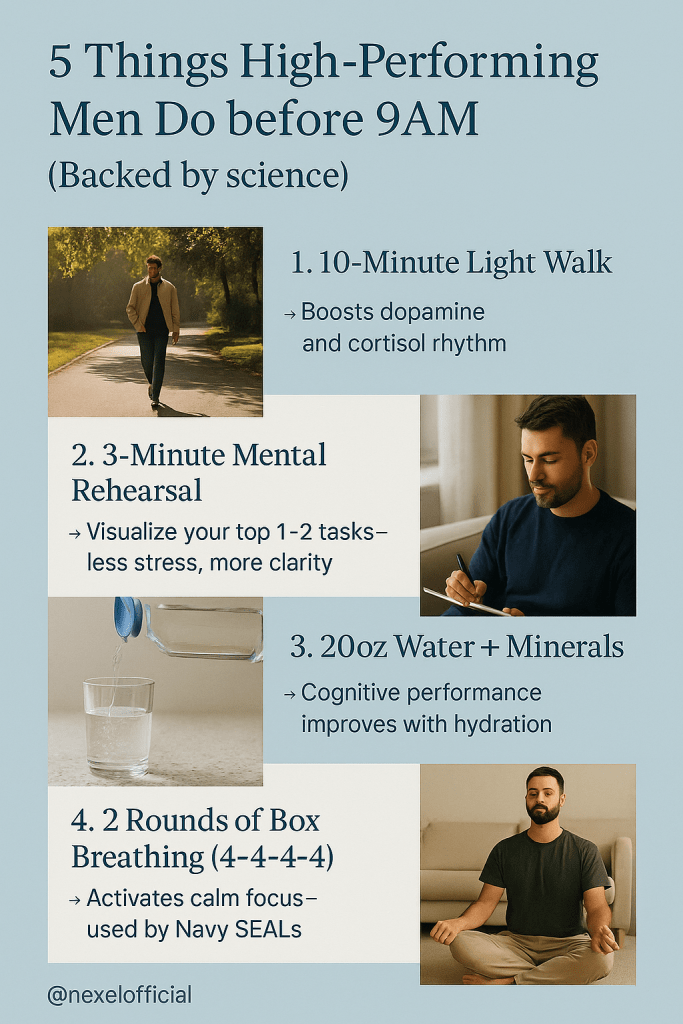
Here are 5 science-backed elements to incorporate into your routine—customizable, time-efficient, and field-tested:
🥤 1. Hydrate First Thing
Your body loses water overnight through breathing and sweat. Mild dehydration reduces cognitive function and mood.
What to do: Drink 16–20 oz of water with electrolytes or lemon.
🔗 Study
🧘 2. Do 3 Minutes of Mental Rehearsal
Mental imagery improves performance, focus, and emotional regulation. Athletes use it. So do Navy SEALs.
What to do: Close your eyes and visualize yourself completing your top 1–2 goals for the day, in detail.
🔗 Research
🚶 3. Move (Even Just a Little)
Light movement increases dopamine and upregulates your circadian rhythm.
What to do: A 5–10 minute brisk walk or a short mobility routine is enough to switch your brain into gear.
🔗 Study
📓 4. Journal With Intention
According to psychologist Dr. James Pennebaker, expressive writing reduces stress and improves cognitive performance.
What to do: Try the 5-Minute Journal or do freewriting (Morning Pages style).
🧘♂️ 5. Practice Box Breathing (Used by Navy SEALs)
Box breathing (inhale-hold-exhale-hold: 4-4-4-4) activates the parasympathetic nervous system, promoting calm alertness.
What to do: 2–3 rounds of box breathing after waking.
🔗 Source
Tim Ferriss-Inspired Morning Routine (15-Minute Version)
If you only have 15 minutes, here’s a minimalist protocol that delivers max ROI:
- 1 min – Make your bed (micro-win)
- 3 min – Box breathing
- 3 min – Mental rehearsal or gratitude journaling
- 2 min – Drink water + minerals
- 6 min – Stretching or brisk walk outside
Want to go deeper? Add:
- Cold exposure
- High-protein breakfast
- Sunlight exposure
- Delayed caffeine for 60–90 mins (per Andrew Huberman)
But… I’m Not a Morning Person. Now What?
Good news: You don’t have to wake up at 5AM to have a morning routine.
Instead, ask: What is the first hour of your day like? Whether it’s 5AM or 9AM, protect the first 60 minutes like sacred ground. Avoid phone checking, reactive tasks, and anything that pulls you into other people’s priorities.
Even one intentional habit—done consistently—can shift your mindset, energy, and momentum for the day.
Final Thoughts: Win the Morning, Win the Day
A great morning routine is not about perfection or productivity theater. It’s about ownership—of your mind, time, and energy.
Whether you follow the Oprah blueprint or the minimalist Tim Ferriss method, the goal is the same: to start the day with clarity and control.
Small, consistent actions compound. And when you win your morning, everything else flows better.
Further Reading & Resources
Have a morning routine that works for you? Share it or tag @nexelofficial — we’d love to feature your ritual in our upcoming roundup of reader routines.
 Nexel Official